Driving lessons
Teaching my daughter to drive this summer had a lot in common with modern medicine and healthcare in 2026. Both my husband and I think we are pretty decent drivers, but things are drastically different than when we each learned to drive years ago. There are more distractions than I ever could have imagined (I remember my book of CDs and detachable face plate) with iPhones and CarPlay, but also just as many new safety mechanisms (think Life360 and seat belt reminders).
While I thought the most difficult part would be teaching parallel parking, the hardest part was actually learning when to hold on and when to let go.
The same is true in leadership, especially in healthcare. Our job is not to have all the answers. Our job is to build capable people and teams, to create psychological safety, and provide support while allowing others the space to develop judgment, build confidence and lead through change.
Welcome to September! For the rest of the year, I need your help with a few key priorities:
- Length of Stay… an extra day? – Quality and Length of Stay are related! Extra days in the hospital increase the risks for hospital acquired infections including catheter associated urinary tract infections (CAUTIs), central line associated bloodstream infections (CLABSIs) and hospital acquired pressure injuries (HAPIs). Our older patients are at particular risk for deconditioning and frailty which can increase the risk for falls and delirium. For most of our patients, an extra day (or days) in the hospital isn’t always what’s best.
- Working towards a “Goldilocks” Length of Stay – So how do we work towards a “Goldilocks” length of stay (one that’s not too long, not too short, but just right)? We take our cues from our physicians and APCs in partnership with Nursing and Care Managers. We want a length of stay that is appropriate for the patient based on their diagnosis, but also that involves care team coordination to ensure patients can go home as close to their medically ready date as possible, avoiding the risks that go along with unnecessary hospital days.
-
- Have open and honest conversations at progression to discharge rounds, at the bedside, and with families involving nursing, care management, and all parts of the care team (as appropriate) about when to expect discharge and what to expect at discharge, including patient and family education about medications and diagnosis.
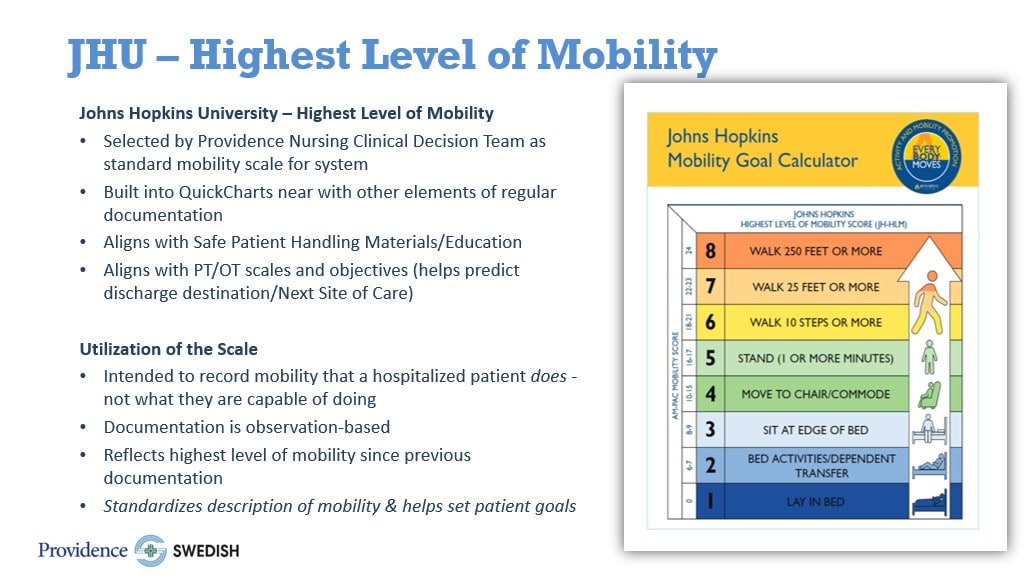
- In addition, we want to ensure patients are mobile! Help us ensure all patients 1) have appropriate mobility orders and 2) document highest level of mobility on admission and 3) preserved or improved mobility (for most) at discharge.
3. Quality Care – Ensuring high-quality care involves balancing the above, so that patients stay long enough to meet their acute care needs, but not so long that they are at risk for preventable harm. You will hear more in the coming months about our collaborative efforts here, including increasing access to care in our community and reducing readmissions.
4. Don’t forget to attend the Annual Medical Staff Meeting on Sept. 15 at Indian Summer Golf and Country Club. Please reach out if you have questions!


