Colon cancer is one of the most preventable cancers when caught early, yet it remains a leading cause of cancer‑related deaths in the United States. Screening is essential because it detects the disease before it spreads and when treatment is most effective.
The power of screening is in prevention. During a colonoscopy, physicians can find and remove precancerous polyps before they develop into cancer. And when cancer is already present, identifying it early gives patients the best chance for successful treatment, often with surgery alone.
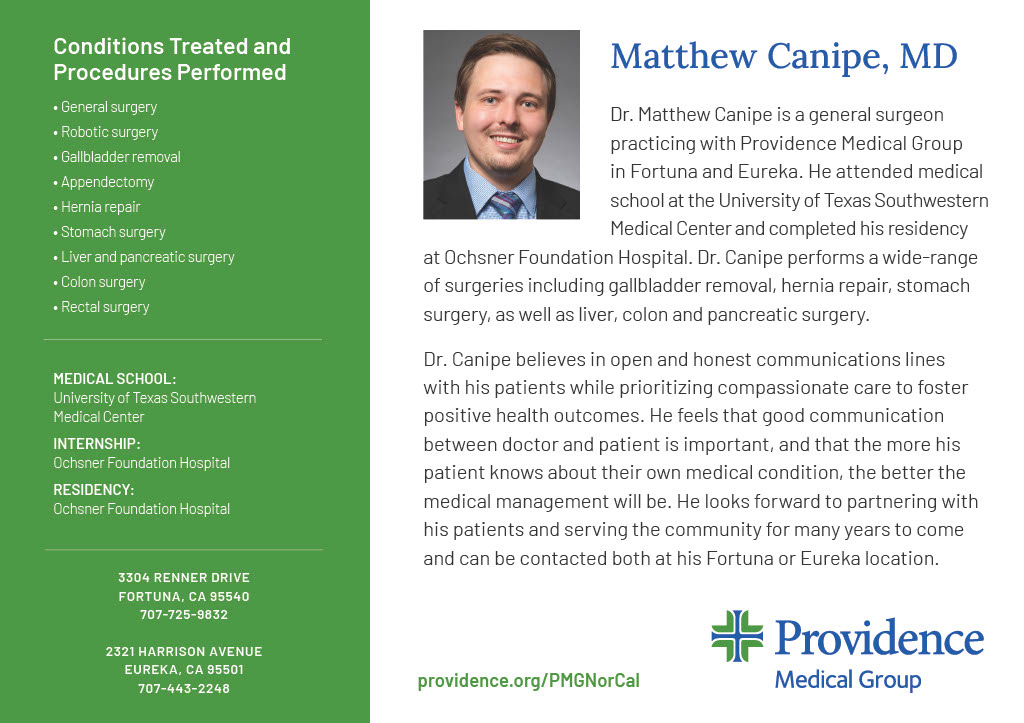
To help the community better understand screening options and the importance of early detection, we asked Dr. Matthew Canipe, a general surgeon with Providence Humboldt, to answer five key questions.
1. Why is colon cancer screening so important, even for people who feel healthy?
“Colon cancer screening has been proven time and time again to save lives,” Dr. Canipe said. “It allows us to find cancers or precancerous lesions before they reach a stage where chemotherapy or other treatments are needed, and when the risk of the cancer recurring after treatment is lowest.”
Because colon cancer often develops without symptoms, screening is the only reliable way to detect it early.
2. When should adults begin screening, and who should start earlier?
In recent years, physicians have seen a troubling shift: more adults under 50 are being diagnosed with colorectal cancer, often at more advanced stages. According to the American Cancer Society, colorectal cancer is now the leading cause of cancer death in men under 50 and the second leading cause in women under 50.
Most adults at average risk should begin screening at age 45.
People at higher risk, including those with a first‑degree relative who has had colon cancer, should start earlier.
“For those patients, we generally recommend starting at age 40, or 10 years before the age at which their relative was diagnosed,” Dr. Canipe said.
3. What screening options are available, and how do they differ?
Screening options fall into two main categories: noninvasive stool‑based tests and colonoscopy.
- FIT and Cologuard analyze stool samples for blood or DNA markers linked to cancer or polyps.
- These tests are intended for people at average risk and can produce false positives because they are designed to avoid missing potential problems.
Any positive stool‑based test must be followed by a colonoscopy, which remains the most comprehensive screening tool.
“Colonoscopy allows us to examine more than 99 percent of the colon lining,” Dr. Canipe said. “We can identify and remove polyps or biopsy anything concerning during the same procedure.”
High‑risk patients should rely on colonoscopy as their primary screening method.
4. What are the most common misconceptions about colonoscopies?
Many misconceptions relate to the preparation process and the procedure itself.
“People often remember the old prep — the large gallon jug — but we now have gentler, more tolerable options,” Dr. Canipe said. “Most of my surgical partners use updated prep protocols that patients appreciate.”
Concerns about discomfort are also common.
“Most colonoscopies are done with the support of an anesthesiologist,” he said. “Patients go to sleep, wake up and that’s the entire experience.”
Mild bloating afterward is normal as the air used during the exam leaves the body.
5. How does early detection change outcomes for patients diagnosed with colorectal cancer?
“Early detection changes everything,” Dr. Canipe said. “When we find cancer in its early stages, there is a lower risk of the cancer recurring down the road compared to advanced stages. We can avoid more aggressive treatments, reduce complications and give patients far more options. Screening truly saves lives.”
For more information about colon cancer screening, please speak with your primary care provider or visit: Cancer Program | St. Joseph Hospital Eureka | Providence
Hospital Eureka and the North Coast Surgical Center, which offers a welcoming
outpatient setting. Your primary care provider can submit a referral to the Providence
Medical Group Gastroenterology Clinic, may call 707-443-4869 to schedule your
appointment.
If you are looking for a primary care physician, contact our clinics at:
Providence Medical Group, Primary Care Eureka | 707-443-9371
Providence Redwood Memorial Hospital, Family Practice Fortuna | 707-725-3318
Learn more about Providence Humboldt General Surgeon Dr. Matthew Canipe below.