

Every 40 seconds, someone in the United States has a stroke. Every 3 minutes, 14 seconds, someone dies from one. Yet for many people, especially those who are healthy, active and “too young,” stroke still feels like something that happens to someone else.
For Dana Rivera, it happened overnight.
At 44, Dana was a healthy, busy mom of four teenagers. She exercised regularly, stayed active and felt strong. A stroke was the last thing on her mind.
Then, everything changed.
Without warning, Dana suffered an ischemic stroke, the most common type, which occurs when a blood clot blocks blood flow to the brain. The event tested her body, her confidence and her sense of identity. It also revealed a new purpose she never expected.
“My world flipped upside down in a moment’s time,” Dana recalls. “Suddenly, I couldn’t move the entire left side of my body. Nothing prepares you for that.”
When the Body Stops Listening
Dana’s stroke was later linked to a previously undiagnosed condition called a “patent foramen ovale,” a small opening between the upper chambers of the heart that does not close after birth. It’s a relatively common condition and, for many people, goes unnoticed until something goes wrong.
For Dana, the stroke forced her to relearn movements most people take for granted. After spending a week in intensive care, Dana entered the next stage of her recovery: rehabilitation. Over the next three and a half weeks, she worked to regain basic movements, relearning how to use her hand, arm and leg.
“I remember thinking, ‘I just want to wear heels again,’” she says. “That became a real goal, something I had to fight for.”
Recovery Is More Than Physical
While Dana was fortunate to regain physical function, recovery was about much more than muscle strength. Emotionally, the journey was just as demanding.
“You have to learn how to trust your body again,” she says. “Even when you’re physically able, the fear doesn’t just disappear. You’re rebuilding confidence every single day.”
What carried her forward was the constant encouragement from her husband, children, extended family and friends. Their belief in her became the spark Dana needed to keep pushing, especially on days when progress felt slow or uncertain.
According to the Centers for Disease Control and Prevention, more than 795,000 people in the U.S. have a stroke each year. Stroke is one of the leading causes of serious, long-term disability. Survivorship often includes physical rehabilitation, emotional and psychological healing.
At Providence Saint John’s Health Center, stroke care is designed as a continuum — beginning with rapid evaluation in the emergency department and continuing through advanced treatment, rehabilitation and long‑term support.
“Stroke recovery doesn’t end when a patient leaves the hospital,” says Jason Tarpley, M.D., Ph.D., vascular neurologist with Pacific Neuroscience Institute at Providence Saint John’s Health Center. “It’s a journey that involves physical therapy, emotional resilience and, just as importantly, community. Support systems make a measurable difference in outcomes and quality of life.”
Turning Pain Into Purpose
As Dana moved forward in her recovery, she began to feel called to do something more with her experience.
“My journey and purpose were to help anybody who has ever struggled with stroke and survivorship, to see that there are silver linings and gratitude in the life you still have,” Dana says. “I really had to work on the gratitude component.”
Dana began volunteering her time at multiple hospitals in West Los Angeles, sharing her story with stroke survivors, patients, caregivers and clinicians. She offered something only a survivor can give: understanding. What started as a single speaking opportunity quickly grew into something more.
Eventually, her advocacy helped shape the peer-led stroke support group at Providence Saint John’s, a program that reflects the hospital’s commitment to whole-person stroke care, addressing physical recovery, emotional healing, caregiver support and meaningful community connection.
The group offers a compassionate, encouraging space where stroke survivors and their loved ones can connect, share experiences and learn from one another. Led by those with lived experience, meetings are held virtually each month. This makes support accessible to both patients and caregivers, regardless of where they are in their recovery journey.
“When you’re a stroke survivor, the emotional impact is hard for anyone else to fully understand,” Dana explains. “This gives people a platform to say whatever is on their mind and remind them that they’re not going through this alone. There’s camaraderie, and that matters.”
Beyond connection, the group also serves as an educational resource, helping participants learn about recovery tools, community services and what life can look like after stroke — reinforcing Saint John’s vision of delivering a personalized and exceptional experience that extends well beyond the hospital walls.
Recognizing the Signs Can Save a Life
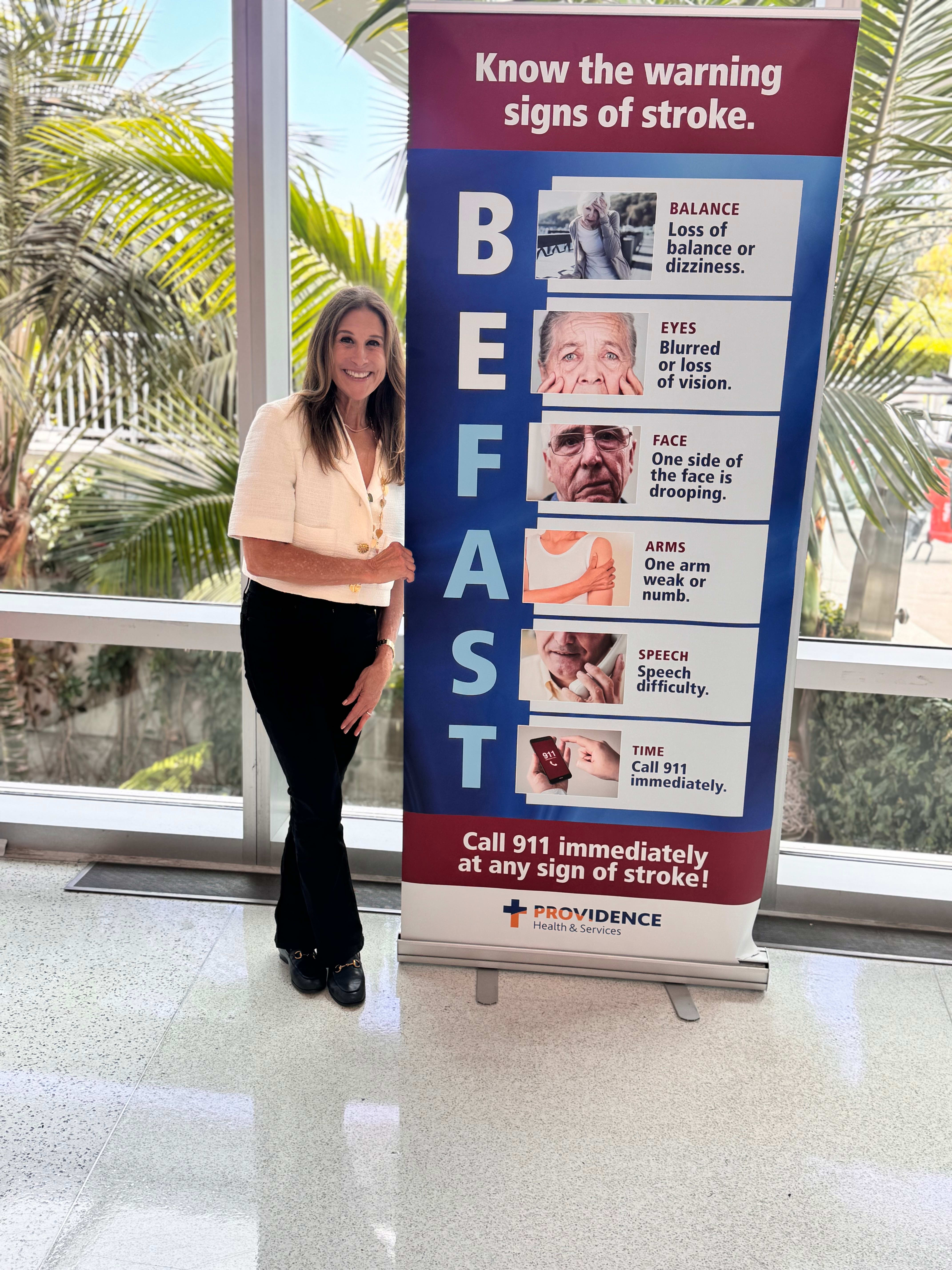
As part of her advocacy, Dana emphasizes the importance of recognizing the warning signs of stroke. Knowing B.E. F.A.S.T. can save a life:
B – Balance: Sudden loss of balance or coordination
E – Eyes: Sudden vision changes
F – Face: Facial drooping
A – Arms: Arm weakness
S – Speech: Slurred or difficult speech
T – Time: Call 911 immediately
“Every second matters,” Dr. Tarpley adds. “The faster someone receives treatment, the better the chance of survival and recovery.”
For Dana, that truth is more than a statistic. It is the reason she continues to lead, mentor and inspire others. While stroke may change a life, it does not have to define its limits.
“There’s life after stroke,” she says. “And sometimes, there’s purpose you never expected.”
Learn more about stroke care and treatment options available at Saint John’s by visiting Emergency Department | Saint John's Health Center | Providence
Contact Dana Rivera to register for an upcoming stroke support group meeting.


