

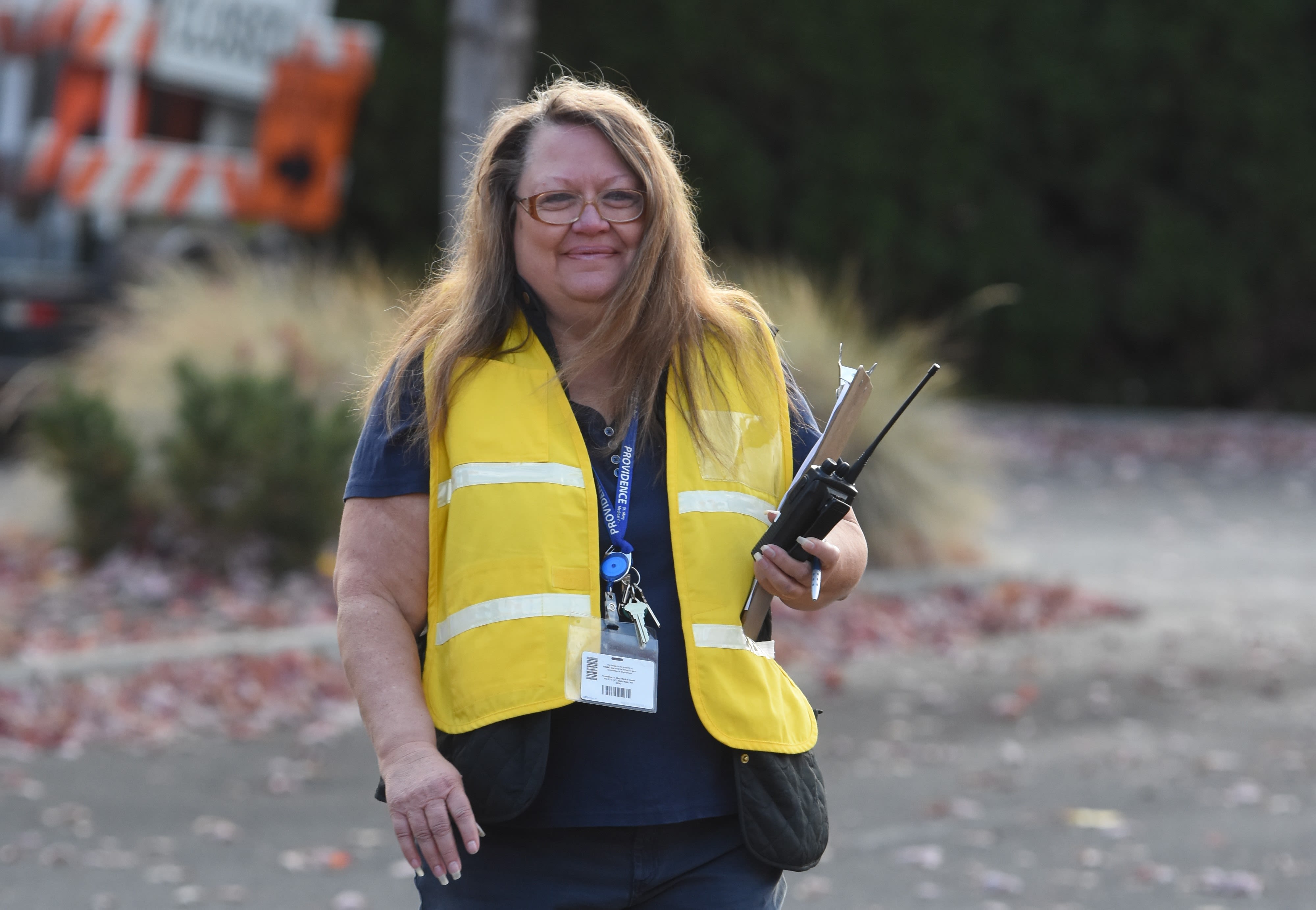
Susan Leathers refers to her 50 years in healthcare as a wonderful adventure. Looking back at her career as she moves into retirement March 1, that may be an understatement.
She helped shape the nature of healthcare not just in Walla Walla, but in Oregon and Washington as well.
“It is hard for me to imagine St. Mary without Susan Leathers,” said Louise Dyjur, Chief Nursing Officer for Providence St. Mary. “She has touched so many people here, caregivers and members of the community alike. She has been a trusted leader and advisor for many of us, and the departments she led have been transformed through her guidance.”
Transformation is Susan Leather’s gift.
Leathers was involved in the formation of the trauma systems in Oregon and Washington, which have saved countless lives by ensuring that critically injured people are rapidly transported to hospitals with the expertise and specialists to treat them.
She worked with late Rep. Bill Grant to open the way for rural hospitals to provide emergency interventional cardiology, providing life-saving care to people who live too far from metropolitan hospitals to get there in time during a cardiac event.
She spent decades preparing Providence St. Mary for a pandemic, so when one came, the processes and relationships with community agencies were already in place for a coordinated response.
She was the first – and still the only – nurse in the Providence system to lead a security department, providing valuable insight into embedding security officers with clinical teams.
Yet with all of this, she is perhaps best known for the depth of knowledge, steady strength, and leadership she has exhibited for decades at St. Mary.
“I believe we work on sacred ground, and we are called to this work,” Leathers said. “Every step along the way, there were opportunities I could not have dreamed of, and they were all what I felt I was called to do. I was never uncertain. I was instantly convinced this is the time, this is the place and I am committed to doing this.”
As a newly graduated nurse, Leathers joined St. Mary in 1976 when it was a tall brick building that would soon be demolished to make way for the current St. Mary.
She became the manager of the Intensive Care Unit in one year.
She didn’t apply for it. Like most of the positions she held over the years, there was a need and Leathers was asked to take it on. Some positions were so new that she wrote the job descriptions for the roles she took.
She never charted a career path or aspired to some grand ambition. Instead, she cultivated skills central to being a strong leader: efficiency, clarity, communication and deep expertise.
“I thought if I did that, everything else would fall into place,” she said.
Caregivers attending her meetings are familiar with her favorite quote from Winston Churchill. Her approach is based on it: “To each there comes in their lifetime a special moment when they are figuratively tapped on the shoulder and offered the chance to do a very special thing, unique to them and fitted to their talents. What a tragedy if that moment finds them unprepared or unqualified for what could have been their finest hour.”
Leathers was always determined to be ready for her finest hour.
In the 1980s, St. Mary recruited two neurosurgeons, Dr. Perry Camp and Dr. Guy Gehling, to St. Mary, transforming the hospital into a trauma treatment center. Leathers trained and prepared the caregivers. She knew they needed to be ready for the challenge ahead.
“One word sums up Susan Leathers: Excellence,” said Dr. Tim Davidson, Chief Medical Officer for Providence Medical Group Walla Walla. “Over the years I’ve heard countless stories about Susan and her remarkable abilities.”
The 1980s were a pivotal in healthcare as states were creating trauma systems. Prior to the creation of Oregon’s trauma system in 1987 followed by Washington’s in 1990, there were no standardized protocols for the treatment of trauma, no formalized hospital trauma teams, and no standardized protocols for Emergency Medical Services to follow in the field to get a patient to a hospital with the right medical resources. Ambulances took trauma victims to whatever hospital was closest. Time was lost, and so were lives.
As Oregon stood up its trauma system, it wrote to St. Mary because so many traumas were flowing across the state line to Walla Walla. St. Mary’s chief executive tossed the letter in the trash, then thought better of it and gave it to Leathers.
“I read it and knew right then we had to do it,” Leathers said. She had three weeks to complete the vast, complex paperwork required.
St. Mary and St. Charles Medical Center in Bend became the first Level II designated trauma hospitals for Oregon. Washington followed suit with its trauma designations in 1990. Leathers served on the trauma system advisory boards for both states for many years. (Oregon later began only providing designations for in-state hospitals).
She was Providence St. Mary Medical Center’s trauma program manager before the Washington trauma system even existed, a role she kept until 2021.
“The trauma systems were among the first real big things I worked on,” she said. “To me, they also are some of the most important because they were of such benefit. That will live on long after me.”
Dr. John Shannon, a semi-retired surgeon who has practiced in Walla Walla with St. Mary for 50 years and served as the trauma medical director for many years, wrote in a note to Leathers, “So many of my memories from the past 50 years involve you. You always amazed me with your knowledge and expertise in every area that you worked, and most notably in trauma. The entirety of the Eastern Oregon and Eastern Washington trauma systems owe a great debt and appreciation to you.”
Leathers used the same skills honed with the trauma systems to work with Rep. Bill Grant to get Washington State to allow rural hospitals to provide interventional cardiology, benefiting rural people across the state.
Her most unusual challenge, however, came later, in 2019 when she was called into the chief executive’s office and asked if she would manage the St. Mary Security Department.
“It was a total surprise,” she said. “I instantly said yes, not knowing what I was getting into. But I was the safety officer. I didn’t think we were using Security the way we could be.”
It was another transformation, not just for her, but for the officers.
“Susan has shaped my leadership with humility, accountability, grace, and trust elevating Security at St. Mary,” said Mike Smith, Security supervisor. “Through her compassionate guidance, I’ve grown as a leader and helped strengthen Security’s role and credibility. She is, hands down, the best manager I’ve ever had the privilege to work for and a dear friend.”
Leathers embedded officers with the clinical teams, trained officers in how healthcare operates, empowered them to do investigations, equipped patrol officers with Narcan, increased cameras, brought in K-9 units, wrote grants to enhance security measures, and taught leadership at all levels.
“I tell the officers all the time, my leadership is training up other leaders, even if they are not in leadership positions,” she said. “Everyone in a uniform is a leader because people are going to look to them as leaders in an emergency.”
In 2020, she was again called into the chief executive’s office. COVID had arrived in Walla Walla. She was asked to serve as pandemic incident commander, a role she held for two and a half years. In the early months, she worked seven days a week, then six days a week for many months more.
“I remember thinking, ‘Why didn’t this happen when I was younger?” she said, laughing. “I felt for a small county, we were pretty well prepared. With our community partners we conducted many drills together over the years. We knew each other and could quickly get on the same page. We managed to vaccinate 30,000 people without outside help, just our community resources.”
As she considered retirement, she initially was somewhat anxious because she didn’t have any specific plans for activities or travel. She and her husband, Dan, will remain in the area at their home in Dixie.
Then as she looked back on her career, she realized that she hadn’t had big plans for that, either, and it had been more fulfilling than she could have imagined. There was no need to worry.
“The way my life has gone, something will come along to compel me, and I will be able to see ‘Oh, this is my next calling’,” she said. “This is what I am supposed to do.”
About the Author
More Content by Providence News Team


