

 Women undergoing treatment for cancer can experience far-reaching side effects. For example, women with breast or gynecological cancers can be thrust into early menopause because of surgical procedures and drug treatments. The changes are often profound, not only affecting how a woman feels about her body but also her intimate relationships.
Ellen MacKay found herself in that situation in 2022, after being diagnosed with endometrial cancer at age 43. In addition to chemotherapy and immunotherapy, Ellen had a total
hysterectomy that forced her body into menopause. It was physically disorienting and emotionally challenging in a way that affected Ellen’s well-being and her sense of self.
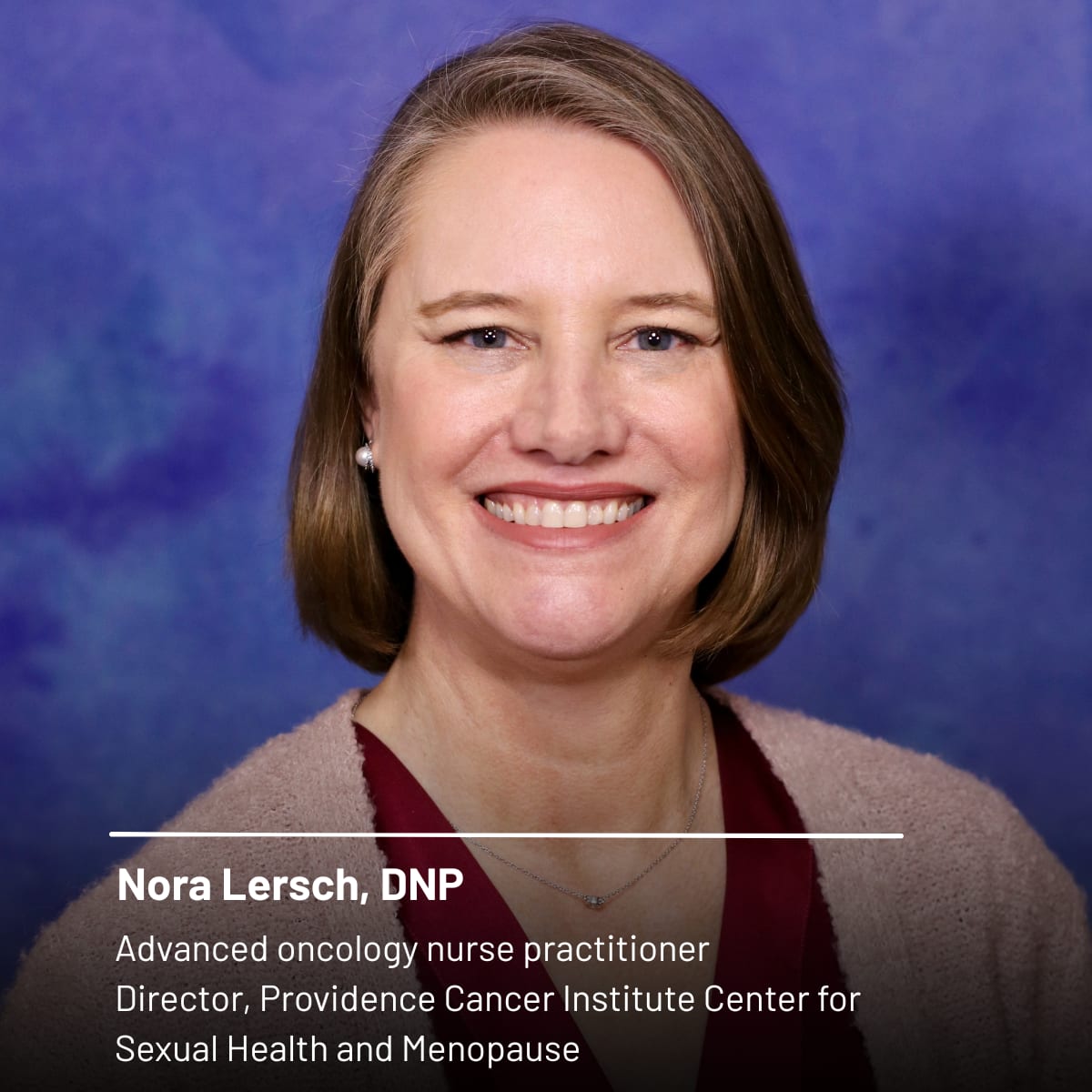
Then she was introduced to Nora Lersch, DNP, a board-certified family and advanced oncology nurse practitioner and director of the Providence Cancer Institute Center for Sexual Health and Menopause. With Nora’s help, Ellen made her way back to feeling more like herself in her body and mind, as well as in her relationship with her husband.
Cancer diagnosis puts busy life on hold
Within days of learning she had cancer, Ellen’s life became a whirlwind of appointments. Her treatments included a total hysterectomy, which requires the removal of the uterus, cervix, both fallopian tubes and ovaries. Three weeks after surgery, Ellen received six rounds of chemotherapy as well as immunotherapy.
A mother of two teenage boys and a yoga instructor, Ellen kept a busy schedule caring for and encouraging others. But during her cancer treatments, all her energy was redirected toward her own healing and managing the side effects as well as the sudden onset of menopause.
“I didn't have enough energy to teach a class. But everyone was so supportive, encouraging, gracious and understanding,” Ellen said.
Managing menopausal symptoms after treatment
Six months after surgery, Ellen’s life started to resemble normalcy. “I felt like I was getting strong again and my energy level was increasing. I was back to teaching and had kind of found my new balance,” Ellen said.
But missing from her new normal was the intimacy she’d had with her husband before the hysterectomy and onset of menopause. Ellen expressed her concerns to her oncologist, Cassandra Niemi, M.D., a gynecologic specialist at Providence Cancer Institute Franz Gynecologic Oncology Clinic.
Dr. Niemi referred Ellen to Nora. “I was definitely a little nervous and also curious,” Ellen said. “I wondered if she would be able to do anything to help me. But she was a very good listener and very patient. She took into account not only what I had been through physically, but also what I had been through emotionally, which is such a huge part of sexual health.”
“Women can feel very medicalized during their cancer treatment and may need to take a step back from their sexual relations with their partner, due to the trauma of the process and side effects,” Nora said. “I encourage women to try to focus on intimacy rather than intercourse to maintain connection. Even small gestures – hand holding or snuggling on the couch – can help maintain your connection to your partner.”
Nora gave Ellen a plan with different ways to help manage the physical effects of menopause. “It was hard at first, but I stayed with her recommendations,” Ellen said. But eight weeks later, Ellen returned to Nora’s office a different person. "I was much happier. The regimen she told me to follow made a bigger difference than I thought possible,” she said.
A plan that works
Part of what made the plan work, was that it didn’t rely on hormone replacement therapy, a treatment commonly recommended for menopause. It wasn’t an option for Ellen because of her cancer type. Instead, Nora offered non-hormonal alternatives.
“There are many options to help women navigate menopausal symptoms if hormone therapy is not recommended because of their type of cancer,” Nora said.
From there, the regimen expanded into exercises Ellen could do on her own, along with new ways for her and her husband to define what intimacy meant to them going forward.
Today, Ellen compares her ongoing routine to physical therapy. “It’s kind of like when you go to PT and you have to do all these things in the very beginning, and you have to stay on top of it. Then you graduate from PT and you realize you still need to do those things to feel good. That’s kind of where I’m at,” she said.
“Sexual health is an important part of one’s quality of life and I believe deserves attention just as any other part of our life or health does,” Nora said. “We spend time exercising or taking care of our skin – our sexual health deserves that attention, too.”
Yoga practice, another tool for healing
 Yoga has played a part in her healing, too. Ellen said her practice has taught her patience with a body that had been through trauma. “A lot of acceptance, a lot of self-compassion, mindfulness and understanding where my thoughts are and how the diagnosis affected how I was feeling inside and out,” she said.
Breathwork, in particular, helped her manage the tension that can come with rebuilding intimacy after treatment. “Understanding tension in my body, how trauma affects my mental space and knowing I could use my breath to calm my nervous system was a huge help,” she said. That perspective shapes how Ellen teaches her students. She talks openly about meeting the body where it is.
One of the biggest takeaways is that she hopes women undergoing treatment for cancer know there are ways to restore intimacy in their lives. “Be gentle with yourself during this process, advocate for yourself and ask questions. This kind of help exists out there.”
Find out more about our care
At Providence Cancer Institute Franz Gynecologic Oncology Clinic patients receive care from our team of experienced and kind professionals in one location. In addition to providing a range of treatments and resources, patients under our care have access to the latest research and clinical trials.
Related news
Dark genome, bright outcome: A first-of-its-kind trial gives Del Abbott a second chance
Q&A: Meet one of the investigational drug pharmacists at Providence


