

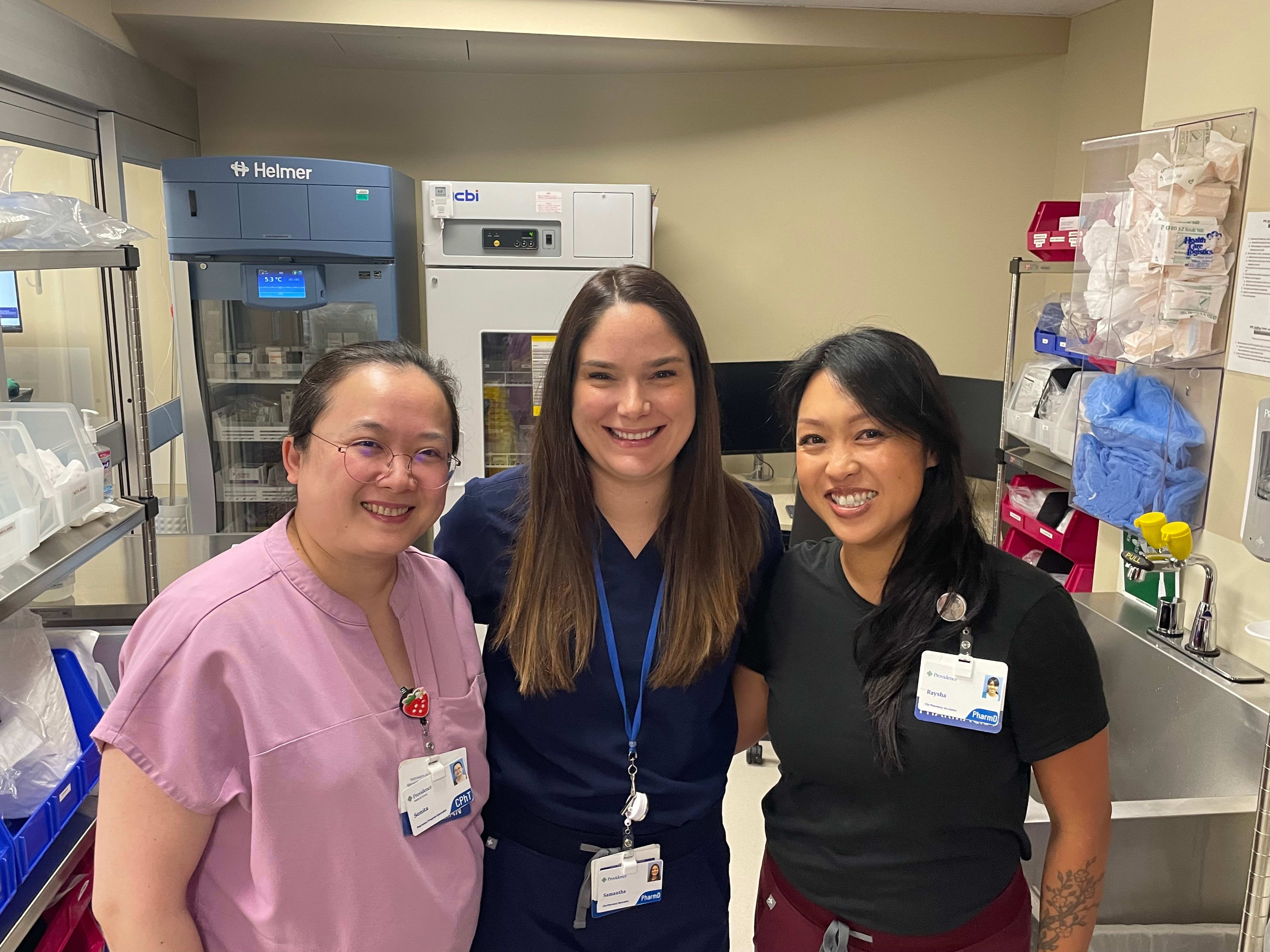
Raysha Sadang is one of four pharmacists on Providence Cancer Institute’s investigational drug services (IDS) team, splitting her time between Providence Franz Cancer Clinic and Providence St. Vincent Medical Center. She's been a pharmacist at Providence Cancer Institute for 15 years and has spent the last several years helping manage the clinical trials her team oversees.
Think of an investigational drug pharmacist as one of the people keeping experimental drugs safe and on track during a clinical trial. They handle the storage, preparation and dispensing of drugs that aren’t fully approved yet, following strict rules to protect patients and keep the research accurate. They work closely with doctors, nurses and other members of a care team to make sure patients get the right doses at the right time, while following Food and Drug Administration (FDA) regulations. In essence, they’re the link between promising new cancer treatments and safe, well-managed patient care.
We sat down with Raysha to talk about what the job actually involves, if the field has changed since she started and what drew her to this work in the first place.
Q: What is your role in clinical trials at Providence?
Our team, which includes four pharmacists and two technicians, gets involved after a study has already gone through all the different approval boards and its protocols have been finalized. But before we ever receive the medications, there's a lot happening behind the scenes.
Once a protocol is approved, part of our team acts as a "build team.” Our director determines what the principal investigator needs, and the drugs get ordered along with detailed instructions on how to prepare and mix them.
We manage how the drugs are dispensed, whether they're given orally or through infusion, and we prepare and mix them for each patient.
So, there's really two sides to it: the behind-the-scenes work of building out the protocol and ordering/preparing instructions, and then the hands-on work of dispensing, mixing and preparing medications for the infusion nurses to administer.
Q: What's involved in figuring out how to handle a new investigational drug?
One of my responsibilities is determining whether a drug is hazardous, based on how it works, and if it's similar to other drugs already on the market. By hazardous I’m referring to whether the medication poses a significant adverse health risk. If it’s hazardous, we determine if it’s low risk or high risk. Based on what we learn, we may change how we mix or administer it to patients.
Q: Providence Cancer Institute has approximately 250 studies open. How do you and your colleagues manage all those studies at once?
Every person on our team is responsible for knowing about all the studies in some way since we never know exactly which ones we'll need to administer on a given day. We run clinical trials at four sites — Providence Franz Cancer Clinic, Providence St. Vincent Westside Clinic, and the Willamette Falls and Newberg clinics – but we only have investigational drug services at Franz and Westside clinics. On most days, we have one pharmacist and a technician at Franz and a pharmacist at the Westside clinic. Each day, we have a schedule that tells us exactly which patients and which studies we'll be working with. The day before, we pull all the paperwork, make sure we can log into each study, and confirm we have the drugs and everything else we need.
Q: What happens when there is a protocol deviation to a study?
I'm not directly involved in that process; it mostly falls to the study nurse with additional oversight from my manager, as needed. If there's a deviation — meaning something that doesn’t happen according to the study protocol or plan — they will talk to the drug sponsor to see if the patient can continue on the study or if the deviation requires that they come off it.
Q: Do you counsel patients in the infusion room?
My role is slightly different in that I work in both the infusion room pharmacy and in IDS. That means I counsel patients in the infusion room on nausea and vomiting management (caused by chemotherapy) when I’m there, and I also counsel our study patients on the days I’m dedicated to my IDS role.
Q: How did you find your way into working with cancer drugs and investigational research?
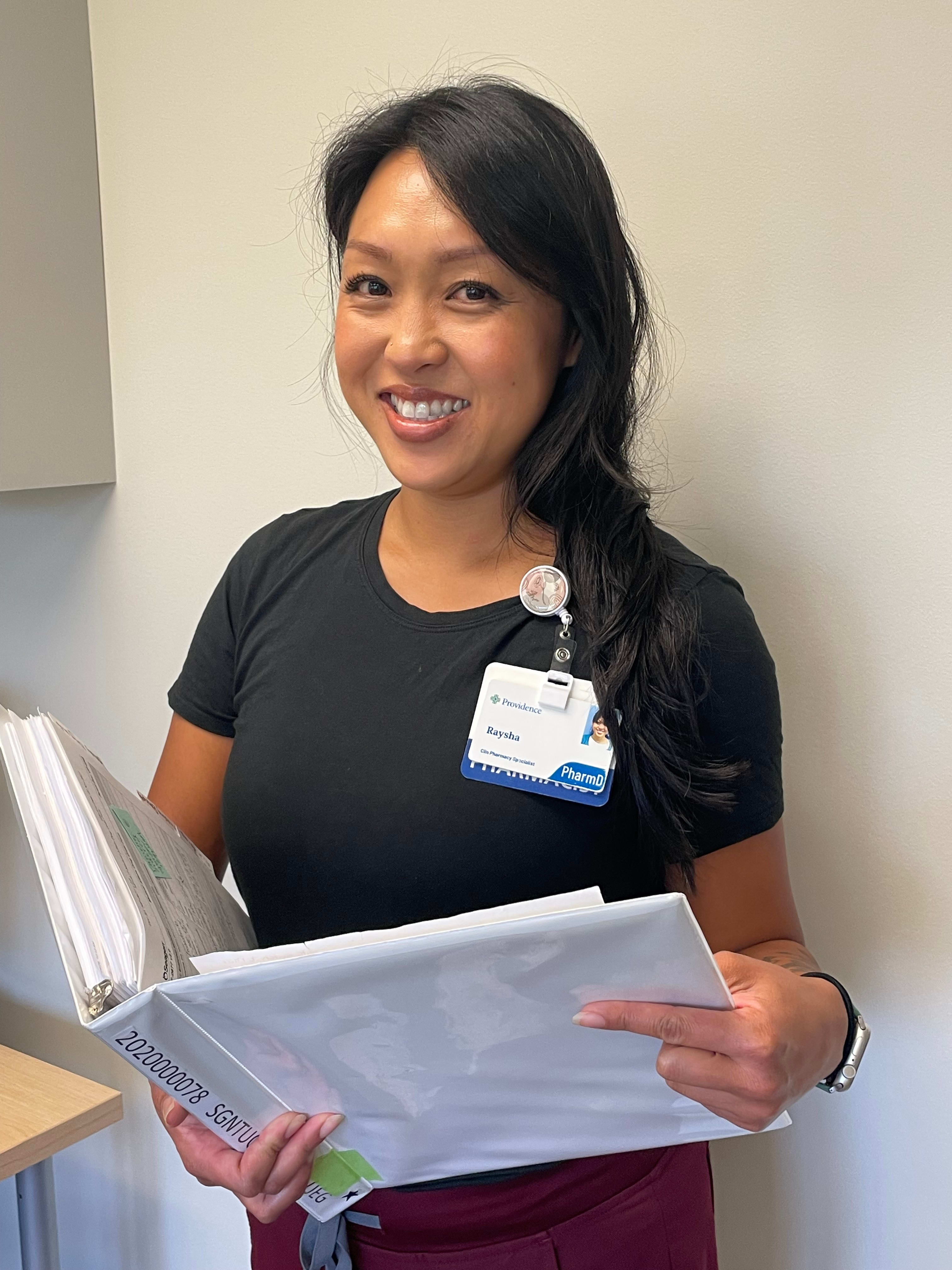 I got into pharmacy work because my best friend in college wanted to pursue it. I was a cell and molecular biology major and so it made sense. My first job was at Virginia Garcia serving underserved patients, but I always wanted to move into inpatient work. Through an agency, I landed a three-month inpatient position at Providence St. Vincent Medical Center during a pharmacist shortage. When the contract ended, they hired me permanently, and I stayed in inpatient care for about 12 years. After I had children, the inpatient schedule — nights, weekends, holidays — became too hard to manage, so I started looking for something different. Some former colleagues had moved into investigational drug services, and when a position opened, I applied and got it.
Q: Did moving into investigational drug work require additional training or certification?
A lot of it is learned on the job; you don’t have to attend special schooling. There’s on-site training at the beginning, which is mainly focused on learning computer tools and doing the necessary paperwork. But every study is unique so I’m learning on an ongoing basis.
Q: What's your favorite part of the job, especially in your current role in investigational drug services?
I like being very involved in helping shape what medicines are available for people in the future. And I can do my job in a way that is still conducive to having a life outside of work. You don't have to work all night and on weekends to feel like you are contributing to medicine or science.
Q: What advice would you give to young women or girls interested in pursuing the sciences?
I would say... you’re needed! I believe women think about things differently than men do, we approach things differently and we have natural abilities that lend themselves to not just science, but to roles in health care.
There is a lot more focus on STEM for girls than when I was growing up, which is fantastic. I hope that continues. But I think there could still be more encouragement for girls to get into science.
Q: What would you say to someone specifically considering a career in pharmacy?
There's so much more that you can do now, so just explore what's out there. When I was growing up, I knew of the stereotypical pharmacy jobs in Walgreens or Rite Aid, not jobs in research or drug development, or being a pharmacist for a big drug company.
Find out more about Providence Cancer Institute
Providence Cancer Institute is one of the leading providers of cancer care in Oregon and a global leader in immuno-oncology. Through its research division, the Earle A. Chiles Research Institute, patients have access to a vast clinical trial portfolio. Learn more about our clinical trials here.
Related news
It started with one bandage, and a patient’s smile
A quiet lifeline: Meet the volunteer at Jill Lematta Learning Center
6 things everyone should know about oncology palliative care


