

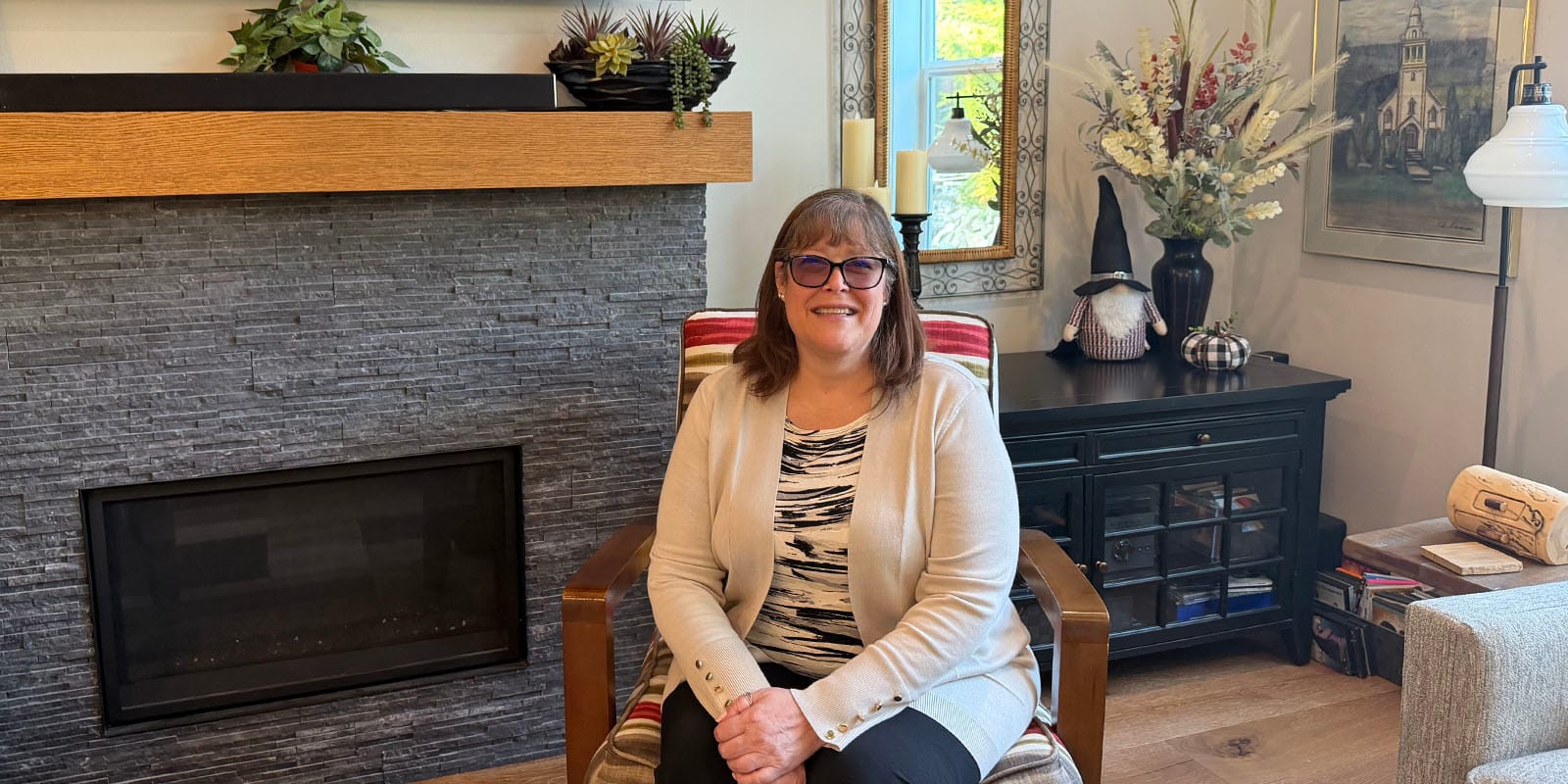
Above: Julie Cropley, senior communication operations specialist, who has been with Providence for 31 years.
November 2026
At age 50, when her doctor started talking about colonoscopies, Julie Cropley had zero interest in getting one done. She asked for other options and chose an at-home screening test.
“The colonoscopy itself didn’t scare me,” Julie remembers. “It was the prep.”
Preparing for a colonoscopy takes a few days. You change to eating low-fiber foods, and then drink liquids only, and then take a strong laxative to empty your colon.
“My biggest fear was that I was going to start drinking the prep, and I was going to start gagging and end up throwing up. Then I was going to go in, and they were going to say, ‘Sorry — you didn’t clean yourself out enough. We need to reschedule your exam.’ And I was going to have to go through it all over again.”
Julie was happy with the home-testing option. Over a few years, she did two home tests that both came back negative.
‘Not nearly as bad as I had hyped it up to be’
But Julie’s daughter, Katie, didn’t think those negative test results were good enough. Katie had worked as a nurse at an endoscopy clinic and knew there are things home stool tests might not catch. The tests check for hidden blood or abnormal DNA. But they can miss precancerous polyps and some tumors.
“I saw people with negative home tests still get an unfortunate diagnosis at a young age. That’s why I always nagged her,” Katie says.
Finally, Julie talked with a doctor who told her she could take pills instead of drinking a liquid laxative to prepare. Then she made an appointment.
“The prep was not nearly as bad as I hyped it up to be,” Julie says. “It’s a few hours of uncomfortable, but not bad. I went in for the colonoscopy, and it was not horrible.”
Julie and her daughter, Katie Fanning, while visiting Julie’s mom, Marie.

Above: Julie and her daughter, Katie, while visiting Julie’s mom, Marie.
Catching cancer early
Right after the colonoscopy, the doctor came in and told Julie that there was a mass in her colon. He took a biopsy and sent it to the lab “stat,” so they’d hear back quickly.
And it was fast. The next day, her doctor called to say, “You have cancer in your colon.”
Colorectal cancer is the second leading cause of cancer deaths in the U.S., and about one in 25 people will be diagnosed with it in their lifetime. Still, the news came as a shock. Julie is the 51st of 56 grandchildren, with 20 aunts and uncles. While a number of them have had cancer, none have ever had colon cancer.
“I feel like I’m the poster child for colonoscopies — no symptoms, no family history,” Julie says. “I’m just thankful that my daughter wouldn’t stop bugging me about it, because the longer I put it off, the worse it could have been. I could still be walking around with cancer and not know I had cancer.”
Preparing for surgery
The type of cancer Julie has — adenocarcinoma — begins in cells that line the inside of many different organs. So, her doctor ordered several imaging studies to look for tumors in other parts of her body. Fortunately, none were found.
Her next stop was an appointment with a colorectal surgeon. Up to this point, she’d been feeling good about catching the cancer early. But the surgeon told her they were planning a major six- to eight-hour surgery: They would remove cancerous portions of her colon and rectum and then reconnect them.
Also, with a visit to an oncologist, she learned the cancer couldn’t be “staged” until surgery. Depending on what they found, she might need more cancer treatment, including chemotherapy or radiation.
“Knowing that I’m a week out from surgery, and not knowing what I’m going to wake up to, is terrifying,” Julie says.
“The surgeon had told me that my goal is to be a survivor of colon cancer. If there are hiccups along the way — a temporary bag [ostomy bag to collect stool], or chemotherapy or radiation — those are hiccups and we’re going to get through that.”
‘One in 25’
Julie has a few positive things she’s focusing on while preparing for surgery: She has a new grandchild who was just born and another due any day — and she’s trying to convince people to get a colonoscopy.
“I have become very passionate about encouraging people to get colonoscopies,” Julie says. “I want to make sure you get this done, so you don’t have to go through what I’m going through.”
Doctors recommend most people get their first colonoscopy at age 45, or earlier if they have a family history of the disease.
“My goal is that if I could get 25 people who are 45 and older, who have no symptoms, who don’t have a family history, who don’t want to have a colonoscopy — if I could get those 25 people to go in and have a colonoscopy, there’s a very high chance that one of them could have cancer,” Julie says.
Here’s what she’s telling everyone: “The stress and anxiety of the prep? It’s nothing, compared to the stress and anxiety of preparing for a major surgery.
“This is a colonoscopy crusade!”
See Julie's story
Related news:
- Learn more about colorectal cancer and schedule an appointment with Providence Cancer Institute of Oregon.
- Share Julie's video, and see more from our talented clinicians and caregivers on Instagram.
- See a story about changes in screening age and new recommendations for screening options.


