

March 2026
At Providence Medford Medical Center, cardiac rehabilitation isn’t just about healing hearts — it’s about helping people reclaim their lives, with care that is personal, supportive and rooted in hope.
When Tess Carstens was wheeled into surgery at Providence Medford Medical Center after a major heart attack and triple bypass, the outcome was uncertain.
“They stopped my husband in the hall and said, ‘Would you like to say goodbye?’” Tess says.
She survived — but recovery was harder than she expected. After leaving the hospital, Tess found herself at home, overwhelmed and unsure of how to move forward.
“Even though the doctors saved my life and all that, I wasn’t doing anything. I was sitting at home, feeling sorry for myself,” Tess says.
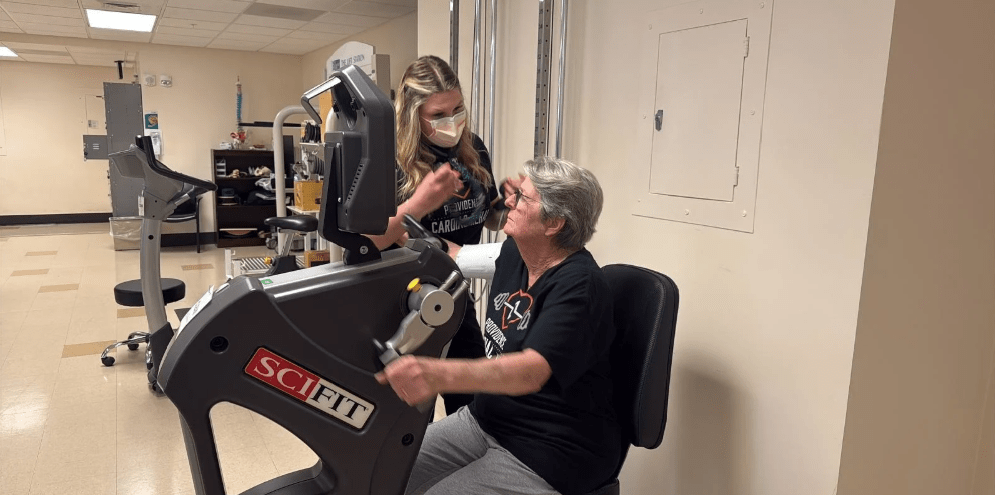
Everything changed when Tess saw a local news story about cardiac rehabilitation at Providence Medford. She reached out, received a referral, and began working with Kendra McMillen, an exercise physiologist who would become a key partner in her recovery.
“It was like starting my life over again,” she says.
When Tess began the program, she could only walk four minutes on a treadmill. She shared a goal with Kendra that felt almost impossible at the time: She wanted to walk a 5K. Step by step, they worked toward it. When Tess was finally ready, Kendra didn’t just help her prepare — she showed up on her day off to walk alongside her.
“When I see my patients succeed, that means I’m succeeding,” Kendra says.
Excellence in cardiac rehabilitation
Providence Medford Medical Center's cardiac rehabilitation program is certified by the American Association of Cardiovascular and Pulmonary Rehabilitation, a distinction earned by few programs nationwide due to its rigorous standards. Patients must demonstrate measurable improvements — including at least a 40% increase in functional capacity — by the time they complete the program.
Tess has seen that progress firsthand.
“Patients come in here with a walker and they walk out on their own,” she says.
The program addresses not only physical recovery, but blood‑pressure control, mental health, tobacco cessation, diabetes management, and overall quality of life — ensuring care is comprehensive and personal.
Life beyond recovery
Even after completing formal rehabilitation, Tess chose to stay connected, continuing supervised workouts several days a week. Today, she walks 30 minutes at a time, with more speed and incline, and has returned to golfing, traveling and keeping up with family adventures.
“It’s euphoric. If you’ve ever fallen over because of pain in your chest, to be able to go to another country and not be afraid you’re going to fall over… I’m grateful,” she says.
She now sends postcards from her travels back to the cardiac rehab team — a reminder of how far she’s come.
“You have to have hope. If you have hope and you’re willing to put in the work, it’s worth it,” Tess says.
Related
- Read original story on KDRV.
- Schedule an appointment with Providence Cardiology - Medford.
- See a story of a mother who's early diagnosis at Providence Heart Institute saved her life.


